E-Bus Alternative for RB 73
Außerfernbahn: Kempten – Pfronten-Steinach
The RB 73 diesel train triggers around 79,000 mandatory horn blasts per year at unprotected level crossings, disturbing local communities. We propose replacing it with a zero-emission e-bus line from Kempten Bus Hub to Pfronten-Steinach.
Kempten has been operating all city bus routes electrically since 2025, with a fleet of 27 eCitaro buses. A new e-bus line of 4 extra buses extends this existing network into the region, saves ~380 t CO₂/year, and offers better mobility. Compared to the planned battery train conversion by 2040 (€69–118M), the e-bus solution costs just ~€4.1M over 15 years.
Act now – before a new diesel train contract (from 2029) locks in the noise for years to come.
Support this initiative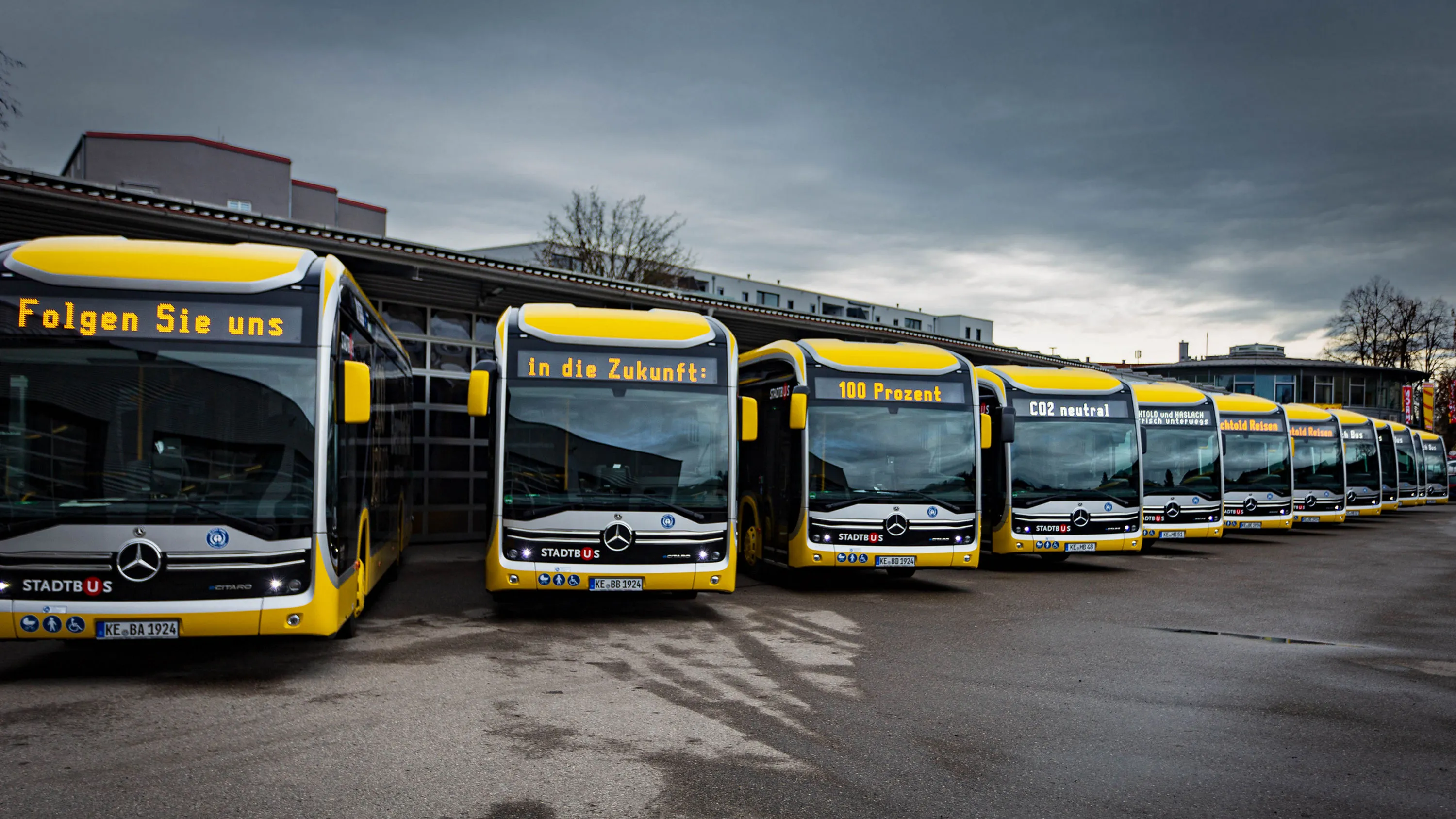
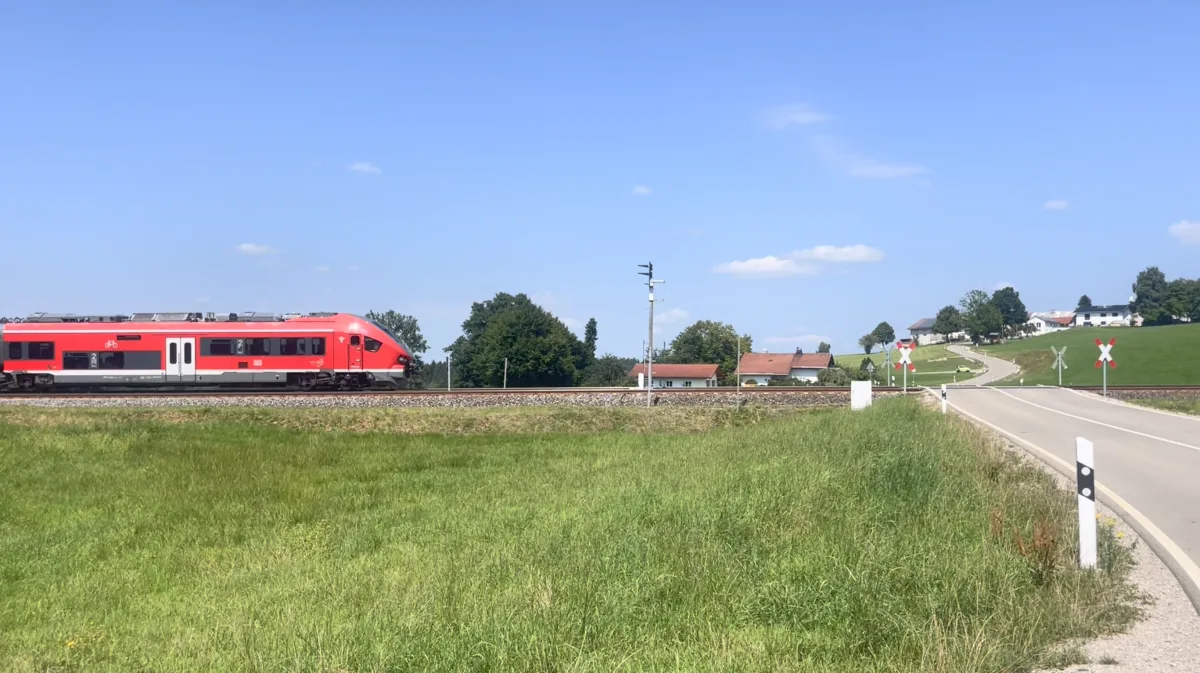
~79,000 horn blasts/year · diesel emissions · high operating costs
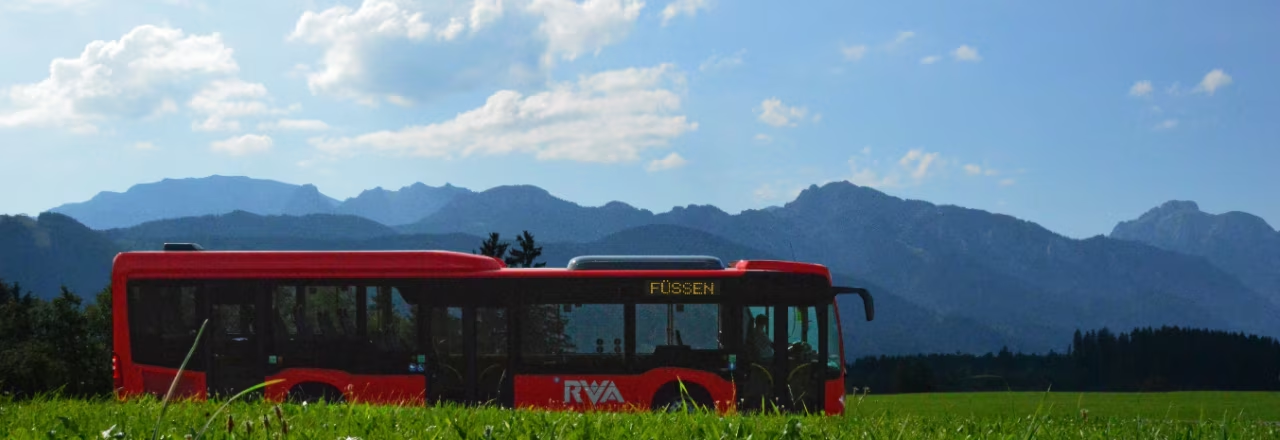
Silent · Zero emissions · ~64% lower operating costs
RB 73 Train vs. Proposed E-Bus Route
33 km rail | 43 km roadThis proposal improves across 4 dimensions
E-buses don't trigger level crossing horns, eliminating around 79,000 horn events per year.
E-buses connect directly to Kempten Bus Hub, enabling seamless transfers to all city bus lines.
Zero-emission e-buses with charging infrastructure shared across municipal fleets.
~64% lower cost over 15 years with up to 80% federal funding for e-bus purchases.
The transport contract is being re-tendered from 2029. Now is the window to bring the e-bus alternative into play.
Noise Reduction: Horn Pollution at Level Crossings
The Außerfernbahn has 16 level crossings in just 12 kilometers – 12 are completely unprotected (Andreaskreuz/crossbuck only, no barriers or light signals) and 4 have electric barriers. [1] At the unprotected crossings, trains must sound their horn (EBO §16). [3] For residents of villages along the line, this means constant exposure to extreme noise, every day, from early morning until late evening.
Under the current two-hourly service (due to staff shortages), ~18 trains/day (~9 per direction) run on this section – all RB 73. No other train service uses this track. At the 12 unprotected crossings (crossbuck only), horn signals are legally required (EBO §16). [3] Replacing RB 73 with e-buses would eliminate all horn events at these crossings.
Case: Sulzberg – Oy-Mittelberg Segment (12 km, 16 level crossings)
How Loud is 110 dB?
🔊 Experience a Train Horn
Recorded 360m from the train line in Oberzollhaus. Turn up your volume to hear what residents experience 216 times per day.
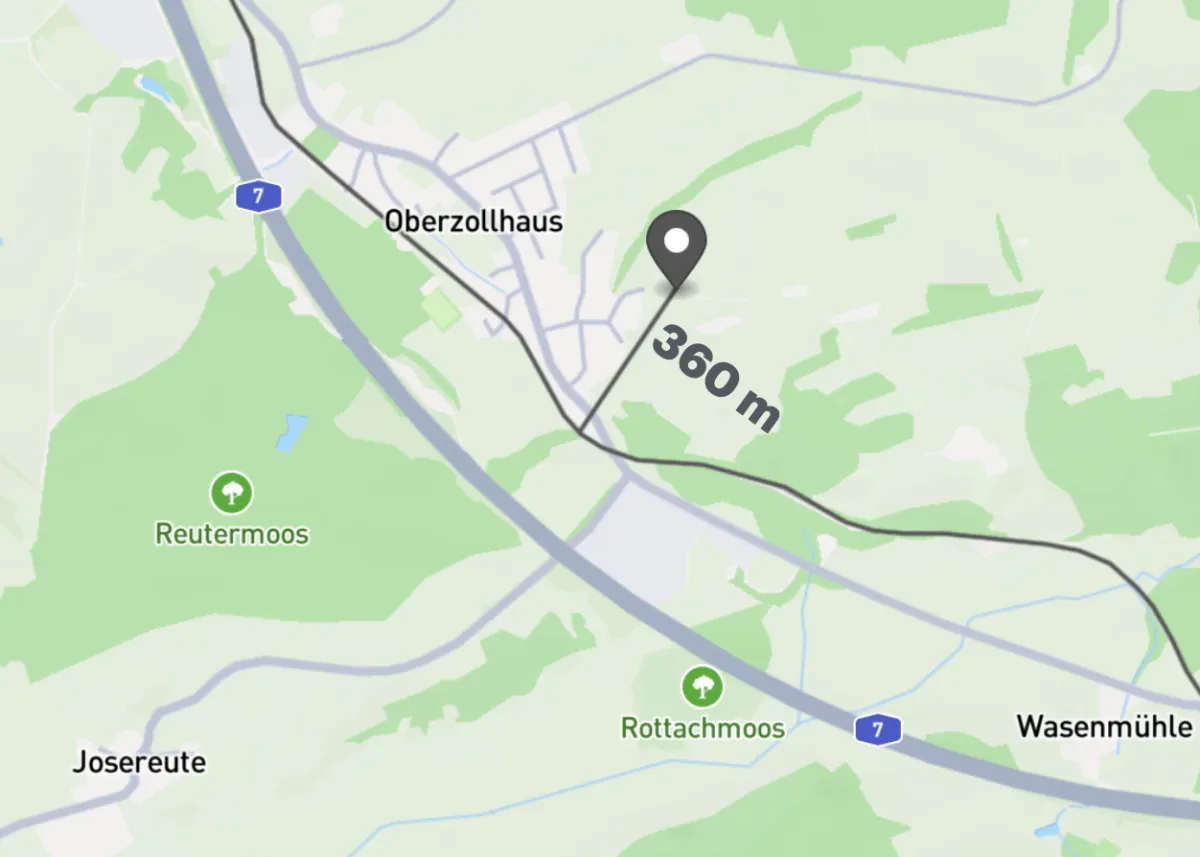
Warning: Loud train horn sound
Health Consequences
WHO Health Impact Thresholds (All Exceeded)
Source: WHO Environmental Noise Guidelines (2018) [4]
Chronic sleep deprivation: Woken before sunrise, every day
The first train from Pfronten departs at 05:17 AM, triggering horn blasts at the 12 unprotected level crossings before 6 AM. For residents along the corridor, there is no sleeping in: not on weekends, not on holidays.
Chronic sleep deprivation health risks:
Adults need 7+ hours of sleep per night. [5]
Communities Most Affected
The Solution: E-Buses Use Roads, Not Rails
E-buses don't trigger level crossing horns. Since RB 73 is the only train service on this track section, replacing it with e-buses eliminates all ~79,000 horn events per year (216/day × 365).
Sources
[1] Crossing data: 16 crossings (12 unprotected/crossbuck only, 4 with electric barriers) based on site visit, OpenStreetMap data, and DB InfraGO infrastructure maps for the Sulzberg–Oy-Mittelberg segment.
[2] Train frequency: Since January 2025, RB 73 operates on a two-hourly schedule (instead of the planned hourly service) due to staff shortages (LOK Report) = ~18 train movements/day (~9 per direction). RB 73 is the only train service on this track section. Trains to Austria (S7) use a different track section from Pfronten-Steinach.
[3] Horn requirements: EBO §16 mandates acoustic warning signals at level crossings; 110 dB minimum per EBO §36. EBO §16, EBO §36.
[4] Health thresholds: WHO Environmental Noise Guidelines for the European Region (2018). who.int.
[5] Sleep guidelines: Adults need 7+ hours of sleep per night. CDC. cdc.gov.
Better Connections: Mobility & Flexibility
Fixed rail lines can't adapt. E-buses connect directly to Kempten Bus Hub, serve communities the train misses, and adjust routes based on demand.
Current Problem: Poor Last-Mile Connections
- ✗ Train terminates at Kempten Hbf, not the bus hub
- ✗ Commuters must wait 5–15 min for city bus connections [4]
- ✗ Villages like Schwarzenberg have no rail access
- ✗ Fixed route can't adapt to events or demand
E-Bus Solution: Flexible, Connected Service
- ✓ Direct to Bus Hub with seamless connection to all city bus lines
- ✓ Coordinated timetables reduce wait times to 2–5 min
- ✓ Can add stops for underserved communities
- ✓ Routes can flex for ski season, festivals, or construction
Example: School Commute from Oy-Mittelberg
Current: Train + City Bus
Proposed: Direct E-Bus
Sources
[1] Train journey time: ~25 min Oy-Mittelberg → Kempten Hbf, DB Regio RB 73 timetable (Dieselnetz Allgäu). Mona timetable Kempten–Oy (PDF).
[2] E-bus journey time: ~20 min estimated from Google Maps driving time Oy-Mittelberg → Kempten ZUM (bus hub) via B309/B12, 43 km road route. Google Maps route.
[3] Bus Hub: Kempten "Zentrum" (ZUM) – transfer hub for all 11 city bus lines. Buses depart in a rendezvous system every 30 min (at xx:25 and xx:55). Mona platform overview.
[4] Transfer times: 5–15 min wait at Hbf – RB 73 arrives at Hbf, but city buses depart from ZUM (~600 m walk between the two). At ZUM: 2–5 min with coordinated scheduling (proposal). Mona network map.
Sustainability & Resilience
E-buses eliminate tailpipe emissions and create resilient infrastructure. The charging depot serves as a foundation for the region's broader electrification, benefiting emergency services, municipal fleets, and future transport needs.
No NOx, particulates, or diesel fumes
Depot serves entire municipal fleet
Proven Success: German Municipalities Lead the Way
E-buses are no longer experimental. Kempten itself has been running electric since 2025, and other cities and rural operators have proven they work reliably, even in challenging alpine conditions.
- • 27 eCitaro buses in scheduled service
- • All regular routes fully electric
- • Depot charging, on-site solar
- • Umweltpreis Schwaben 2025 winner
- • 2 e-buses in daily operation
- • 900m+ elevation, harsh winters
- • Year-round service since 2021
- • 100+ e-buses operational
- • Target: 100% electric by 2035
- • Depot charging model proven
- • 23 e-articulated buses in service (since 2025)
- • Target: 100% electric by 2035
- • Steep terrain, tourism demand
Sources: PwC E-Bus Radar 2025 [2], DB/RVA Oberstdorf [3], MVG München [4], Stadtwerke Konstanz [5]
Future-Proofing: One Investment, Many Uses
The charging depot isn't just for buses. It's foundational infrastructure for the region's entire electrification strategy. As EVs become standard, this depot becomes increasingly valuable:
Why This Matters for Resilience
- • Energy independence: Solar + battery storage reduces grid dependency
- • Emergency readiness: Charged vehicles available 24/7 for crisis response
- • Technology-agnostic: Infrastructure works with any future EV technology
- • Scalable: Can expand as municipal fleet electrification grows
Preparing for Germany's EV Transition
Germany's private EV fleet is growing rapidly. Rural villages like those along the Außerfernbahn corridor will need robust electric infrastructure, and the e-bus charging depot provides a foundation.
How E-Bus Infrastructure Benefits Private EVs
- • Grid upgrades: Depot charging requires grid capacity improvements that benefit the entire area
- • Expertise: Local operators gain EV maintenance and charging knowledge
- • Public charging: Depot could offer limited public charging during off-peak hours
- • Signal effect: Visible municipal EV commitment encourages private adoption
Don't Let Villages Fall Behind
Kempten already operates 27 e-buses with its own charging infrastructure, but villages along the corridor risk being left behind. Young families and professionals increasingly expect modern, sustainable transport options. Without them, rural areas become less attractive places to live.
Why This Matters for Village Growth
The opportunity: By investing in e-bus infrastructure now, villages like Oy-Mittelberg, Nesselwang, and Pfronten can offer the same modern transit experience as larger cities, making them attractive alternatives for people priced out of urban areas.
What about winter performance?
The route is only 43 km. Even with 27–48% winter energy loss [6], a round trip needs ~140 kWh in the worst case, and any eCitaro variant can be specced to easily meet this: eCitaro solo (NMC3): up to 588 kWh, eCitaro solo (NMC4, from 2026): up to 666 kWh, eCitaro G articulated (NMC4): up to 777 kWh. With overnight depot charging, heat pumps, and pre-conditioning, each bus starts the day fully charged. RVA Oberstdorf [3] has operated e-buses year-round since 2021 at 900m+ elevation, higher than the entire proposed route.
Sources
[1] CO₂ savings: Estimated based on UBA emissions data. BR 633 DMU: ~80 L diesel/100km × 2.65 kg CO₂/L = ~2.1 kg CO₂/km. RB 73 service: 33 km × 17 trips × 365 days = 205,755 km/year × 2.1 kg = ~430 t CO₂/year eliminated. E-bus fleet adds ~50 t (German grid mix), net savings ~380 t/year. umweltbundesamt.de.
[2] German e-bus adoption: ~10% of city bus fleet electric (end 2024), ~16% of new registrations. PwC E-Bus Radar 2025.
[3] RVA Oberstdorf: Alpine e-bus operations since 2021, 900m+ elevation, year-round service. gruen.deutschebahn.com.
[4] MVG München: Germany's largest e-bus fleet, 100+ e-buses operational. mvg.de.
[5] Stadtwerke Konstanz: 23 e-articulated buses in service, target 100% electric by 2035. stadtwerke-konstanz.de.
[6] Winter performance: 27–48% increased energy consumption. NOW GmbH winter study.
[7] KBA Vehicle Statistics: 1.4M+ EVs registered in Germany (2025). kba.de.
[8] EU 2035 Regulation: All new cars must be zero-emission from 2035. ec.europa.eu.
Cost Savings: Comparison & Funding
Until 2040: Diesel Train or E-Buses?
A 15-year Total Cost of Ownership analysis shows e-buses cost ~64% less than continuing diesel train service. Federal funding previously covered up to 80% of vehicle costs (BMV – directive expired end of 2025, successor program expected). [1]
Diesel Train (RB 73): 15-Year TCO
E-Bus Fleet (4 buses): 15-Year TCO
Based on 30-minute frequency 3.108.000 €
Note: E-bus operating costs (0,33 €/km) cover energy and maintenance [6]. Driver wages are not listed separately as they are comparable for both train and bus operations and largely cancel out in the comparison. A detailed feasibility study should include full personnel costs.
Federal & EU Funding Programs
BMV E-Bus Funding
- • Previous funding: up to 80% of vehicle costs
- • Up to 40% of charging infrastructure
- • Directive expired end of 2025 – successor program expected
- • Application via NOW GmbH
Additional Funding
- • EU Clean Vehicles Directive – procurement targets for low-emission vehicles
- • Bavaria state co-funding (RZÖPNV / Klimabus program)
- • KfW low-interest loans for sustainable mobility (Program 267)
- • Saved operating costs offset remaining investment
Still Cheaper Without Federal Funding
The e-bus calculation above assumes 80% federal funding (BMV program, directive expired end of 2025). Without funding, the e-bus TCO is ~6,87 Mio. €, still ~40% cheaper than the diesel train (11,5 Mio. €). The e-bus advantage holds in both scenarios.
Sources
[1] Federal funding: BMV e-bus program (up to 80% vehicle costs, directive expired end of 2025). bmv.de, now-gmbh.de.
[2] E-bus vehicle costs: ~580.000 € for 12m solo bus. PwC E-Bus Radar 2025. Average 577.000 €, range 403.000–718.000 € (real procurement data from 1.489 buses). BMWK study.
[3] Diesel multiple unit: BR 633 (Alstom Coradia LINT 41), ~3 Mio. €/vehicle. Reference: 52 LINT 41 for Saxony-Anhalt diesel network, ~170 Mio. € total (~3,3 Mio. €/unit). Bahnblogstelle.
[4] Train operating costs: Estimated 500.000 €/year. Reference: nationwide SPNV average ~15 €/train-km (of which ~9 € subsidy requirement), LNVG 2015 data. Bavaria task authority: BEG (Bayerische Eisenbahngesellschaft). Network-specific costs are confidential. LNVG SPNV costs, BEG Bavaria.
[5] Track access charges: SPNV track prices rise 3% in 2026 (statutory track price brake). Average ~4,86 €/train-km (LNVG 2015). RB 73: 33 km × 17 trains × 365 days = ~205.000 train-km/year. Bundesnetzagentur track prices 2026, DB InfraGO TPS 2025.
[6] E-bus operating costs: Estimated ~0,33 €/km (energy + maintenance), derived from VLP field data: e-bus operating costs are roughly half those of diesel buses (~0,65 €/km). Omnibus Revue. Energy consumption: ~1.3 kWh/km (VDV average, 12m solo bus). EMCEL/VDV.
[7] Charging infrastructure: ~800.000 € estimated for full 4-bus depot (chargers, grid connection, civil works). Reference: ~130.000 €/bus. Kempten already has depot infrastructure [8], so only ~300.000 € needed for expansion. Stadtwerke Konstanz.
[8] Kempten e-bus infrastructure: 27 eCitaro buses in operation, depot charging with PV solar and 2 MWh battery storage. Operators: Berchtold and Haslach. Mercedes-Benz / eCitaro Kempten.
From 2040: Battery Train or E-Buses?
Bavaria aims to end diesel rail services by 2040 [5a]. The current plan for RB 73 is a conversion to battery trains (BEMU). These charge under overhead wire at Kempten Hbf, expected as part of the Buchloe–Kempten electrification around 2032–2035 [5b]. E-buses could be operational from 2028.
Battery Train (BEMU)
- Track renewal (28 km): €42–70M [6]
- Crossing protection (12): €6–9M [4]
- New trains (2–3 BEMU): €16–24M [7]
- Charging infrastructure: €5–15M [5c]
+ implementation: 10+ years
E-Bus
- 4 buses + charging infra + operations
- TCO over 15 years (with funding)
- Uses Kempten's existing infrastructure
- No track or crossings needed
Ready in 12–18 months
| Battery Train | E-Bus | |
|---|---|---|
| Horn blasts | 216/day (unchanged) [3] | 0 |
| Journey time Kempten–Pfronten | ~54 min (same track) | ~50 min (road) |
| Frequency | Two-hourly | Every 30 minutes |
| Stops | 13 (fixed route) | Flexibly expandable |
| CO₂ savings | ~380 t/year | ~380 t/year |
| Implementation | 10+ years | 12–18 months |
The Track Itself Is the Problem
Maximum speed is 70 km/h, limited by the track superstructure (downgraded to class A in 2015 [1]), tight curves, and Alpine topography. Journey time is ~54 minutes for 33 km. Just renewing the track bed over 28 km would cost €42–70M (approx. €1.5–2.5M/km, comparable to the Werdenfelsbahn programme [6]). That is for the track alone, without crossings or new trains. Full electrification would be even more expensive at €1.4–3.6M/km [2], which is why battery operation is being considered. But a battery train still runs just as slowly on the same track.
Switching Propulsion Does Not Eliminate Noise
EBO §16 mandates acoustic warning signals at level crossings regardless of propulsion. A battery train sounds its horn just like a diesel train. Protecting all 12 crossings would cost an additional €6–9M [4], but this is not included in any current plans. All 216 daily horn blasts would remain even with a battery train. E-buses run on roads and trigger zero horn blasts.
Even if battery trains are the goal: e-buses are the ideal bridge solution
Even those committed to battery trains long-term need a solution until 2040. While the track is renewed to a higher class and the 12 unprotected level crossings are fitted with barriers, e-buses handle local transport – quietly, emission-free, and with better frequency. Residents benefit immediately, and the track can be upgraded faster and more cheaply without ongoing passenger service. A new diesel contract (2029–2032+) would be the worst option in either scenario: it locks in the noise, blocks track renewal, and delays both the e-bus and the battery train solution.
Sources
[1] Track class: Downgraded from C3 to A between Durach and Pfronten-Steinach on 16 July 2015 due to substructure deficiencies. Wikipedia: Außerfernbahn.
[2] Electrification costs: BMV cost comparison: single-track lines €1.4–3.6M/km depending on topography. BMV Cost Comparison.
[3] Horn signal requirements: EBO §16 mandates acoustic warning signals at level crossings regardless of propulsion. Minimum 110 dB (EBO §36). EBO §16.
[4] Crossing protection costs: Half-barrier installation: €500,000–750,000 per crossing. Cost-sharing under Eisenbahnkreuzungsgesetz (EKrG): 1/3 each for railway, federal government, and road authority. EKrG.
[5a] BEG Allgäu Study – 2040 diesel phase-out: "Der Freistaat Bayern möchte den Einsatz von Dieselverkehren im bayerischen SPNV bis 2040 beenden." (Ch. 1, p. 7). Zeithorizont 3 = all lines battery-electric by 2040 at the latest (Ch. 3.2, p. 20). Total investment for the entire Allgäu network: €329–365M (Ch. 2.1, pp. 9–10). Implementation: min. 10 years (Ch. 10, p. 123). BEG Announcement, Study (PDF, 202 pp.).
[5b] BEG Allgäu Study – RB 73 as BEMU line: RB 73 Kempten Hbf – Pfronten-Steinach is listed as a conventional line (no tilting technology) using BEMU 45, 2 vehicles per train (Table 3-3, p. 26). Simulation shows: the BEMU charges under overhead wire at Kempten Hbf and covers the 65 km round trip on battery – minimum SoC 45%, above the 30% safety threshold (Table 7-3, p. 73). Prerequisite: the Buchloe–Kempten line must be electrified. The study's implementation plan has overhead wire reaching Kempten around ~2032–2035 at the earliest (Fig. 10-1, p. 125). In Jan. 2026, a planning contract was signed only for Buchloe–Biessenhofen – still ~25 km short of Kempten. Study (PDF), Tables 3-3 & 7-3, Bayern.de: Planning contract Jan. 2026.
[5c] BEG Allgäu Study – Charging infrastructure: Charging stations in Füssen (~€10.2M) and Krumbach (~€12.6M) planned for BEMU operations (cost table Ch. 9.4, p. 120). Study (PDF), Table 9-4.
[6] Track renewal costs: DB investment programme Werdenfels/Oberland: ~€100M for approx. 45 km of track renewal on comparable single-track Alpine lines in Bavaria (2023). Approx. €2.2M/km. DB Press Release.
[7] BEMU vehicle costs: VMS Saxony / Alstom Coradia Continental BEMU: 11 three-car trains for ~€70M (vehicle cost, 2020), approx. €6.4M/unit. ÖBB / Stadler FLIRT Akku framework: up to 120 three-car trains, approx. €10.8M/unit. Estimate €8M/unit (midpoint, inflation-adjusted). Alstom Press Release, IRJ: ÖBB/Stadler.
Critical Timing
The RB 73 is at a critical juncture. The current transport contract ("D-Netz Allgäu Los 1" with DB Regio) will be re-tendered as "Dieselnetz Allgäu Übergang" – running from December 2029 to December 2032, with an option to extend to 2035 [1]. If a new diesel contract is signed now, the region will be locked into the status quo for another 3–6 years.
Decision Window 2027–2029
The tender for the transitional contract will be prepared over the next 1–2 years. Now is the moment to bring the e-bus alternative into the political discussion – before the tender documents are finalized.
Service Already Degraded
The RB 73 currently operates only at a 2-hour frequency instead of hourly – due to staff shortages [2]. This shows: the diesel train is already failing as a reliable solution. An e-bus running every 30 minutes would be a real improvement.
Investing in Outdated Infrastructure
Platforms at Pfronten stations are currently being rebuilt [3]. Every euro spent on infrastructure for a replaceable local service is a missed opportunity to invest in future-proof e-bus infrastructure instead.
Electrification Confirms the Approach
The 1.5 km section from the Austrian border to Pfronten-Steinach was electrified in 2021 [4]. Through-trains (Reutte, Garmisch) run electric there – but the RB 73 shuttle remains on non-electrified track and continues running diesel. This partial electrification makes the local diesel service even more redundant.
The tender is being prepared now – without intervention, millions will again be committed to a diesel contract (2029–2032, with option to extend to 2035), even though the e-bus solution would be cheaper, cleaner, quieter, and better connected.
Sign the petition nowSources
[1] Transport contract: BEG pre-information notice for "Dieselnetz Allgäu Übergang" tender – Dec 2029 to Dec 2032, with option to 2035. Current contract "D-Netz Allgäu Los 1" with DB Regio. lok-report.de.
[2] Degraded service: RB 73 running at 2-hour frequency since January 2025 due to staff shortages. Dieselnetz Allgäu Los 1 had the highest cancellation rate of all Bavarian networks in 2024 at 14.5%. lok-report.de, BEG cancellation data.
[3] Platform rebuilding: Barrier-free upgrade at Pfronten-Ried station (construction started July 2024, ~4 Mio. €). Nesselwang station also being rebuilt. deutschebahn.com, allgaeuhit.de.
[4] Außerfernbahn electrification: 1.5 km border–Pfronten-Steinach section electrified since December 2021 (~2,1 Mio. €). Electric trains run continuously Munich–Garmisch–Reutte–Pfronten. Bavarian Transport Ministry.
Less noise, better connections, lower costs
Sign the petition nowAccelerated Implementation Timeline
Planning & Approvals
This study provides the foundation. Finalize route details and secure political buy-in.
2–3 monthsFunding & Fleet Procurement
Submit funding applications. Kempten's operators already have procurement channels with Daimler Buses [8]. Lease initially or order additional eCitaros through existing contracts.
3–4 monthsExpand Existing Infrastructure
Kempten's bus operators already run depot charging with PV solar and 2 MWh battery storage for 27 eCitaros [8]. Add a few charger slots for the regional fleet, no new depot needed.
1–2 monthsPilot Service
Launch e-bus service alongside existing train. Validates operations and builds rider confidence before full cutover.
3–6 monthsFull Replacement
Discontinue RB 73 local service. E-bus becomes the primary Kempten–Pfronten connection, integrated into Kempten's existing electric bus network.
OngoingKey accelerators
- • Infrastructure already exists: Kempten's operators run 27 eCitaros with depot charging, PV solar, and battery storage [8]. Just expand, don't build from scratch.
- • Proven operators: Berchtold and Haslach already operate the same bus model daily [8]. No learning curve needed.
- • Established procurement: Existing supplier relationship with Daimler Buses enables fast ordering or leasing.
- • Phased rollout: De-risks transition by running pilot alongside train
Estimated total timeline: 12–18 months from project approval to full operation
Executive Summary
The Proposal
Replace RB 73 local train service (Kempten ↔ Pfronten-Steinach) with a zero-emission e-bus line connecting directly to Kempten Bus Hub. RB 73 has been the only train service on this section since 2020 (through-running to Reutte ended). The rail infrastructure remains in place and is available for occasional freight or special services.
Noise Reduction
12 of 16 level crossings in 12 km are completely unprotected, triggering 216 horn blasts daily (110 dB each). RB 73 is the only train service on this section (two-hourly service due to staff shortages) – e-buses eliminate all ~79,000 horn events per year.
Better Connections
In many cases e-buses are faster because trains must slow to 10-20 km/h at each of the many level crossings. Direct to Kempten Bus Hub enables seamless transfers to all city bus lines.
Sustainability & Resilience
Zero-emission e-buses save ~380 t CO₂/year. Shared charging infrastructure closes the rural gap, giving villages the same modern transit as cities, attracting young families and remote workers.
Cost Savings
15-year TCO: ~4,1 Mio. € (e-bus) vs 11,5 Mio. € (train). Previous federal funding covered up to 80% of vehicle costs and 40% of charging infrastructure (BMV – directive expired end of 2025, successor program expected).
Key Clarification
- • Rail infrastructure remains in place
- • No through-services affected (Kempten–Reutte through-running ended in 2020)
- • Track available for occasional freight or special services
- • RB 73 local trains → e-buses
- • Terminus: Hbf → Bus Hub (better connections)
- • Frequency: every 30–60 min
Time-Critical: Contract Tender Approaching
The current RB 73 transport contract will be re-tendered as "Dieselnetz Allgäu Übergang" (term 12/2029–12/2032, option to 2035). The tender is being prepared over the next 1–2 years. If no action is taken now, a new diesel contract will lock the region in for another 3–6 years. Learn more →
Frequently Asked Questions
Is bus capacity sufficient for all passengers?
▼
A modern articulated bus seats up to 120 people, a standard bus 80. With a 30-minute frequency and 4 vehicles, total capacity is substantial. Additional trips can be added during peak demand (e.g. ski season). Exact RB 73 ridership figures would need to be determined as part of a feasibility study to optimally size the fleet.
What happens to DB employees?
▼
DB staff can be reassigned to other routes in the Allgäu network. Additionally, bus drivers, maintenance and administrative staff are needed for the new e-bus service. Experience shows that such transitions reassign rather than eliminate positions.
Why not a battery train instead of e-bus?
▼
A battery train (BEMU) needs the same degraded track (renewal: €42–70M), triggers the same horn blasts at unprotected crossings (protection: €6–9M), plus new trains and charging infrastructure. Total: €69–118M, 10+ years to implement. The e-bus achieves the same goal (zero-emission operation) for ~€4.1M in 12–18 months, with better frequency (30 min vs 2 hrs) and flexible routing.
Isn't rail fundamentally greener than bus?
▼
On heavily used routes, yes. But RB 73 runs diesel railcars on a non-electrified line carrying only a few dozen passengers per trip. A zero-emission e-bus is actually greener in this case: it saves ~380 t CO₂ per year compared to the diesel train, and the shared charging infrastructure benefits the entire region.
Will the rail line be shut down?
▼
No. The rail infrastructure remains in place. RB 73 has been the only train service on the Kempten–Pfronten-Steinach section since 2020 (through-running to Reutte ended). The track remains available for occasional freight or special services.
Can I still use my DB ticket or Mona pass?
▼
Fare integration would need to be arranged as part of the implementation. Since the e-bus replaces RB 73 on the same corridor, recognition of existing DB tickets and Mona passes would be logical. The Mona Allgäu fare system already covers both buses and trains in the network. A detailed feasibility study should clarify fare integration with DB Regio and Mona.
How does accessibility compare?
▼
Modern low-floor e-buses offer level boarding at every stop, making them often more accessible for wheelchair users, parents with strollers, and elderly passengers than trains. Many stations on the route lack step-free platforms. E-buses can also flexibly serve new on-demand stops.